There’s a whole world of earrings out there between the plain stud and the statement chandelier. Huggies, climbers, cuffs, jackets, threaders – this guide covers the lot. Find out what each style actually is, where it sits on the ear, and who it tends to suit, so next time you’re browsing you’ll know your hoops from your huggies – and maybe find a style you’d never thought to try. See all of our Sterling Silver earrings here.
Threader earrings
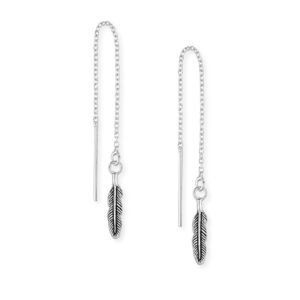
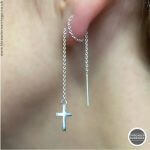
Threaders have a fine post at one end that you thread through your ear. They have a thin chain (or sometimes a fine piece of wire) that you gently pull through to your chosen length. The chain is very fine – usually a piece of cable or box chain – so it doesn’t hurt to pull it through your ear piercing. There’s usually a little decoration at the opposite end that sits in front of your ear, with the post sitting behind.
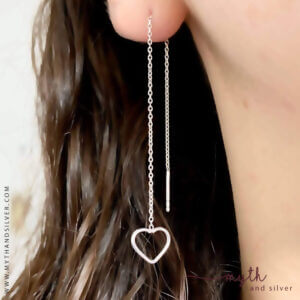
There are many ways to wear threader earrings – especially if you have multiple piercings. See our post on 9 ways to wear threader earrings or view all of our threader earrings here.
Stud earrings
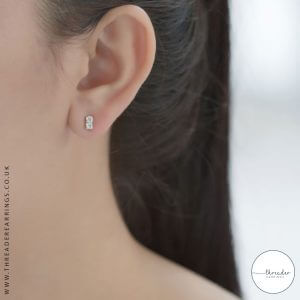
Stud earrings are a small decorative front held in place by a straight post and a back, sitting flush against the ear. They’re the pair most of us start with, and often the one we reach for on autopilot: simple, comfortable, and hard to get wrong.
One thing worth knowing: a standard stud won’t necessarily fit every piercing. Placements like the conch, tragus or helix often need a specific style – usually a flat back (sometimes called a labret) rather than the traditional butterfly back – because a normal post can sit awkwardly, catch, or irritate in those spots. So if you’re buying for anything beyond the lobe, it’s worth checking the earring is actually designed for that piercing rather than assuming any stud will do. See all of our stud earrings here.
Ear climbers

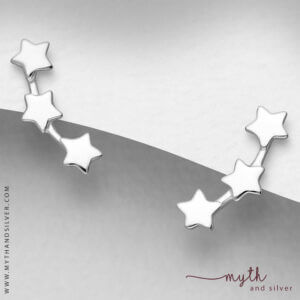
Ear climbers – also called crawlers – are the earrings that curve upwards and trail along the edge of your ear, so a line of stones or shapes appears to climb the ear rather than dangle from it. You put the earring in to a lobe piercing then turn it around so it curves up the ear and squeeze gently to hold it in place. See our ear climber earrings here.
Drop earrings
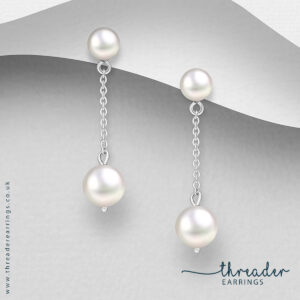
Drop earrings hang below the earlobe, with the decorative part suspended from a stud, hook or other fitting. They can be short and simple or longer and more elaborate, and may feature gemstones, pearls, charms, chains or decorative shapes. Unlike studs, the design extends below the ear, adding a little more movement and length. You can see our drop earrings here.
Pull-through earrings
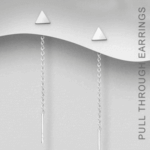
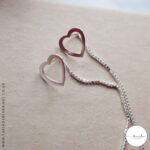
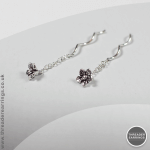
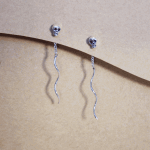
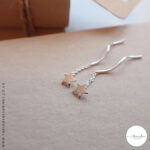
Sometimes people use the words ‘threader’ and ‘pull through’ interchangeably, but it will be immediately obvious to you why they are not the same. A pull-through earring has a decoration at one end, and it is intended that this sits against your ear lobe. It has a thin bar at the other. You thread the thin bar through your ear, all the way through, until the decoration reaches and sits against your lobe. See our range of pull through earrings.
Ear jackets
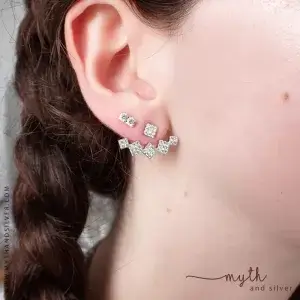
Ear jackets have a really unique two-part design: they have a stud at the front, and a piece that sits behind the ear which threads onto the stud post before you add the back. Watch Courtney put some ear jacket earrings on, in this TikTok video:
@threaderearrings Ear jacket earrings have 3 pieces: the front decoration attached to the post, the hanging chain, and the earring back. The effect is similar to pull-through earrings. Here’s how they work! #earjacket #earjacketearrings https://www.mythandsilver.com/ear-jacket-earrings/
Ear jackets are especially cool as you can chop and change how you wear them – for example, put the back piece in front of the lobe behind the stud for yet another look. See all of our ear jacket earrings here.
Ear cuffs
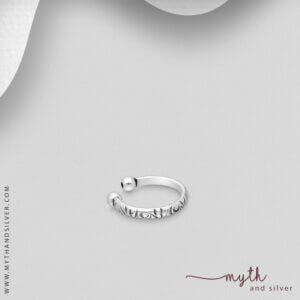
Ear cuffs sit around the edge of the ear rather than hanging from a piercing. Most simply slide over the thinnest part of the ear and are then moved into position, where the cuff gently grips the cartilage. That makes them an easy way to add the look of another piercing without actually getting one.

You don’t normally need a piercing to wear an ear cuff, although some designs combine a cuff with a threader earring that does go through the lobe. This can be arranged in different ways, especially if you have more than one lobe piercing, for a really original and dramatic look. See our ear cuffs here.
Hoop earrings
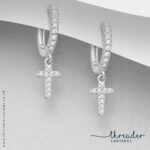
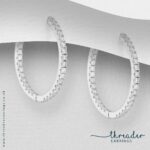
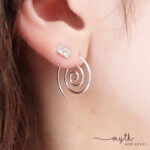
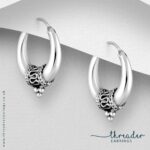

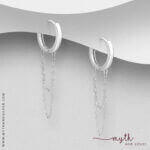
There are so many different types of hoop, it’s not really a single category! Above are just a small selection of the types of hoops we sell – huggies, sleepers, charm hoops, hinged hoops – each of which sits and fastens slightly differently.and there are many more styles.
You will hear the term ‘huggie hoops’ a lot as this is a very popular style. It simply means the hoop is small – it sits close to the ear (see top left photo).
Click here to see all of our hoop earrings.
Hook and wire earrings
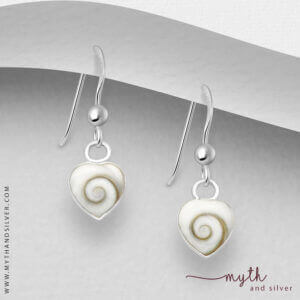
Hook and wire earrings are one of the most familiar earring styles. Instead of a straight post and butterfly back, they hang from a curved wire that slips through the piercing, leaving the decorative part of the earring free to move below the lobe. You’ll also hear these fittings called fish hooks, shepherd hooks or French hooks. They’re especially common on drop and dangle earrings because the simple wire fastening works well with charms, stones, beads and longer designs.
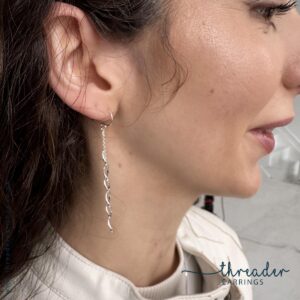
They can range from tiny, delicate drops to much longer statement earrings, but the basic idea has barely changed: a simple curved wire through the ear with the design suspended beneath it. See our collection of hook and wire, and other types of earring.
Double piercing earrings
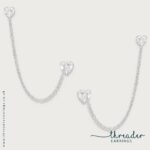
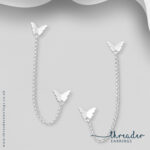
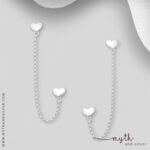
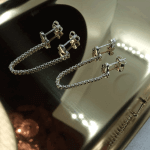
These earrings deserve their own mention, as they come in two main forms: either a threader earring long enough to go through two (or more) piercings, or two stud earrings linked by some chain. We stock both types and they do go out of stock often so it’s worth checking back regularly to see what we have. See our double piercings earrings.
Piercing earrings
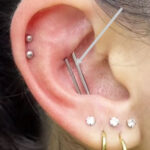
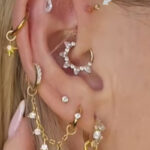
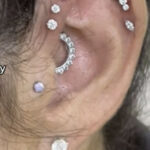
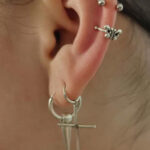
There are a great many earrings that serve the main types of ear piercings you can get (see our ear piercing chart). Aside from having some conch earrings in from time to time, we don’t typically sell these type of earrings.
Industrial or scaffold bars: These are long, straight barbells designed to pass through two separate piercings, usually across the upper ear.
Barbells: These consist of a straight bar with a ball or other end at either side. They come in different thicknesses and lengths and can be worn in various ear piercings as well as other body piercings. Curved barbells are a variation on the same basic design.
Circular barbells or horseshoes: Circular barbells are curved into an open ring or horseshoe shape, normally with a ball, cone or decorative end on each side. They give much of the appearance of a hoop while leaving a visible gap between the two ends.
Captive bead rings or ball closure rings: A captive bead ring, also known as a CBR or ball closure ring (BCR), is an almost complete hoop with a bead held between its two ends. Unlike a conventional ball-ended hoop, the bead is held in position by the tension of the ring.
Labret or flat-back studs: Labrets are a type of stud with a straight post and a flat disc at the back rather than a conventional butterfly fastening. The front can be very simple or highly decorative, and flat-back studs are commonly available in different post lengths and gauges.
Segment rings and clickers: Segment rings look much like continuous hoops, but a small section of the ring opens or comes away so the earring can be inserted. Many modern versions are hinged clicker rings, where that section swings open and clicks securely back into place.