For some people, horses are a hobby. For others, they take over the weekends, the wardrobe, the car, the bank balance and quite a large part of their personality.
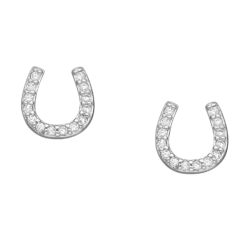
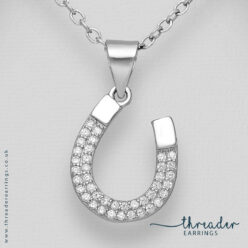
Our horse jewellery is for the latter group – and anyone else who simply loves equestrian designs. This collection includes sterling silver horse earrings and horse pendants, with designs ranging from recognisable horse motifs to traditional horseshoes.
The pieces are small enough to wear every day, so you don’t have to be heading to the yard or a show to wear them. A pair of horse stud earrings works just as easily with jeans as it does with riding clothes, while a silver horse pendant makes a lovely everyday necklace.
Horse and equestrian jewellery also makes an easy gift when you’re shopping for somebody who rides. You may not know their horse’s rug size, favourite bit or exactly what goes into the bewildering collection of bottles in their tack box – but you probably know they’ll appreciate something horse-related.
Showing all 3 resultsSorted by latest
Horse jewellery has been around for a very long time
Putting horses on jewellery is certainly not a modern idea. The Metropolitan Museum of Art has a bronze horse-shaped pendant from Iran dating somewhere between the first millennium BC and first millennium AD, while another tiny horse amulet in its collection was made in Egypt between around 200 BC and AD 200.
There are some surprisingly elaborate later examples too. The British Museum has a sixteenth-century gold horse pendant decorated with enamel, rubies and pearls.
So while today’s equestrian jewellery might be worn because somebody loves their pony, competes, rides for pleasure or just likes the design, there is a remarkably long history behind the idea of wearing a horse as a personal ornament.
Horses wore jewellery too!
There is another nice twist to the history: for centuries, horses themselves were decorated with metal pendants.
Medieval horses could have elaborate ornaments attached to their bridles and other tack. The British Museum notes that horses in the Gothic period were often richly decorated, while surviving harness pendants give us a glimpse of what their equipment once looked like. The Met also has fifteenth-century Spanish and Portuguese horse-trapping pendants decorated with heraldic arms, mottoes and religious designs.
Apparently humans deciding that horses needed accessories as well is not a recent development.
Why horses keep appearing in jewellery
There doesn’t have to be a hidden meaning behind a pair of horse earrings. Sometimes you wear horses because you like horses.
Even so, the horse lends itself particularly well to jewellery. Its outline is instantly recognisable, and designers can use everything from a complete horse to a head, hoof, horseshoe, stirrup or bit.
That influence reaches well beyond jewellery made specifically for riders. Some of the world’s best-known fashion houses have repeatedly borrowed from equestrian equipment.
Hermès actually began as a harness-making workshop in Paris in 1837. Its first jewellery design inspired by that heritage appeared in 1927, and the company still uses shapes taken from bits, stirrups, harnesses and horses in its jewellery today.
Gucci’s famous Horsebit is another example. The double-ring-and-bar motif comes directly from equestrian hardware; Gucci says the design dates back to the 1940s and became a dedicated jewellery collection in 2004.
In other words, equestrian style has wandered a very long way beyond the stable yard.
Why are horseshoes supposed to be lucky?
The horseshoe is one of those symbols that almost everyone recognises, even if they have never been near a stable. Give someone a horseshoe pendant and they are quite likely to read it as “good luck” before they read it as “horse”.
That association goes back a long way. In Britain, horseshoes were once treated as protective objects rather than simply cheerful lucky charms. English Heritage describes them as one of the best-recorded objects used historically to ward off witches and evil spirits. Horseshoes were nailed above doors, and the custom survived well into the nineteenth century.
Part of the belief seems to have been connected with the iron itself. Iron had a reputation in European folklore for keeping witches, fairies and other unwanted supernatural visitors at bay. The Ashmolean Museum notes that horseshoes were once taken very seriously as protection against witchcraft precisely because they were made from iron.
There is also a wonderfully dramatic explanation involving St Dunstan, the tenth-century saint who later became patron saint of blacksmiths. According to the legend, the Devil asked Dunstan to shoe his hoof. Dunstan instead nailed the horseshoe on so painfully that the Devil begged him to remove it, agreeing in return never to enter a place protected by a horseshoe. It is folklore rather than documented history, but the story was certainly well established by the nineteenth century: the British Museum holds an illustrated 1852 publication devoted to The True Legend of St Dunstan and the Devil; showing how the horse-shoe became a charm against witchcraft.
Over time, the idea seems to have softened from keeping bad things out to simply bringing good things in. That is how most of us understand the horseshoe today.
Should a lucky horseshoe point up or down?
This is where folklore becomes wonderfully unhelpful.
One tradition says the horseshoe should sit like a U, with its ends pointing upwards, so that it catches and holds the luck. Turn it upside down and, supposedly, the luck falls out.
Another tradition says exactly the opposite: points down allows the luck to pour over anyone who passes underneath it.
There is historical evidence for downward-facing horseshoes being used protectively too, so there really is no single ancient rule everyone followed. If you’re wearing a horseshoe necklace or earrings, you can therefore choose the version you like without worrying that you’ve accidentally put your luck on backwards.
Horseshoes, weddings and new beginnings
The link between horseshoes and good fortune also makes them particularly suited to milestones.
Luck customs involving shoes have a long history in Britain. English Heritage records the tradition of throwing old shoes after people setting out on a journey, and after newlyweds as they left their wedding, as a way of wishing them luck. The horseshoe eventually became a familiar wedding good-luck symbol in its own right.
That makes horseshoe jewellery rather more meaningful than the shape might first suggest. A little silver horseshoe can be given for a wedding, a new job, an exam, a competition, moving home or any other occasion when “good luck” is exactly what you want to say.
And for a horse lover, of course, you get two meanings for the price of one: horses and luck.
Horse earrings or a horse necklace?
This mostly comes down to how obvious you want the horse theme to be.
Horse stud earrings are probably the easiest option for everyday wear. Small designs can be recognisably equestrian when seen up close without dominating everything else you’re wearing. They’re also a good choice for someone who doesn’t normally wear large or dangling earrings.
A horse necklace or horse pendant gives you a little more room for detail. It can sit on its own as the main piece of jewellery, particularly with a simple top or jumper, and is a good option if you’re buying a gift but aren’t sure whether the recipient has pierced ears.
There is no rule against wearing both, either. If the designs are fairly small, matching horse earrings and a pendant needn’t look like you’ve turned up wearing the entire contents of the tack room.
Horse jewellery as a gift
Buying for somebody who owns a horse can be difficult because horse equipment is remarkably personal. Riders have opinions about saddles, bridles, boots, brushes, treats and seemingly every other item that enters a stable. Jewellery is rather safer.
It can also be surprisingly personal if you choose the motif carefully. A horse silhouette suits somebody who simply loves horses; a horseshoe can double as a good-luck gift; and more obviously equestrian designs are ideal for somebody who rides or competes.
Horse jewellery can work particularly well for:
- birthdays and Christmas;
- a first riding lesson or first pony;
- passing a riding exam;
- a first competition or show;
- thanking a riding instructor or yard friend;
- celebrating a new horse or pony;
- somebody who has loved horses since childhood.
And unlike yet another horse mug, it doesn’t require cupboard space.
Equestrian jewellery isn’t just for riders
One reason horse designs have lasted so well is that they don’t necessarily look like novelty jewellery.
The clean curve of a horseshoe, the outline of a horse’s head and the shape of a bit or stirrup can all work simply as attractive jewellery designs. That’s why equestrian references continue to appear in mainstream fashion as well as in jewellery made specifically for horse lovers.
There is royal precedent too. Queen Camilla has worn a diamond-and-enamel galloping racehorse brooch at major racing events including Ascot, while Queen Elizabeth II was famously closely associated with racing and was given a racehorse brooch for her 90th birthday in 2016.
You certainly don’t need a stable of racehorses to get away with it.
Choosing sterling silver horse jewellery
Sterling silver works particularly well for smaller equestrian designs because it gives enough contrast for the shape to be clear without making the piece feel heavy.
Look for 925 sterling silver, meaning the alloy contains 92.5% silver. Small details such as a horse’s ears, mane, legs or the open centre of a horseshoe can be much easier to see in a bright polished metal than in a more ornate design.
Clear cubic zirconia can add sparkle without taking away from the shape, particularly on horseshoes and small stud earrings.
If you’re buying for everyday wear, size matters too. Check the measurements rather than relying purely on the product photograph: close-up jewellery photography can make an 8 mm earring look enormous.
A small way to wear something you love
Perhaps that’s the real appeal of horse jewellery. It doesn’t need to announce that you ride, own a horse or spent most of your childhood asking your parents for a pony.
It can simply be a small reminder of something you love.
Whether that’s a tiny pair of horse earrings, a lucky horseshoe or a favourite equestrian necklace, it’s a considerably easier way of taking a horse with you than the real thing.